
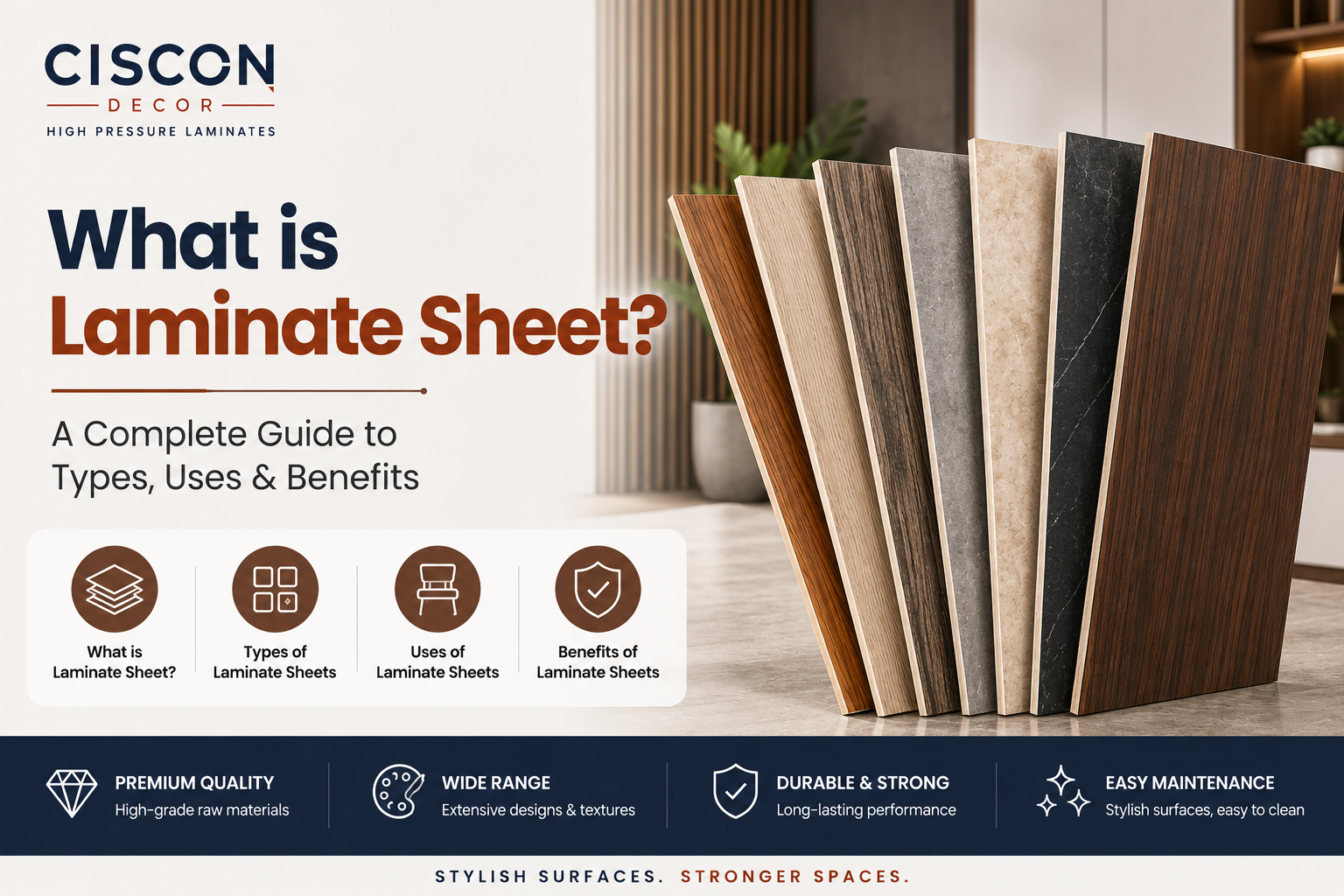
What is Laminate Sheet ? A Complete Guide to Types, Uses & Benefits
If you've ever renovated a kitchen, bought new wardrobe shutters, or browsed furniture at a showroom, you've almost certainly come across the word "laminate." But what is laminate sheet, exactly, and why has it become the go-to surface material for modern interiors ?
This guide breaks down everything you need to know — from how a laminate sheet is made to the different types available, their real-world applications, and how to pick the right one for your kitchen, wardrobe, or furniture project.
A laminate sheet is a thin, flat decorative surface material made by fusing layers of paper (or other base material) with resin under high heat and pressure. It's applied over particleboard, plywood, or MDF to give furniture and interior surfaces a durable, attractive finish that resists scratches, stains, and moisture — without the cost or weight of solid wood or stone.
Key Takeaways
- A laminate sheet is a multi-layer, resin-bonded surface material used to cover furniture, cabinets, walls, and countertops.
- The two main categories are high pressure laminate sheets (HPL) and low-pressure laminates, each suited to different applications.
- Decorative laminate sheets come in hundreds of finishes, including matte, gloss, textured, wood-grain, and stone-effect designs.
- Laminate sheets are valued for durability, affordability, easy maintenance, and design flexibility.
- Choosing the right laminate sheet for kitchen, wardrobe, or furniture use depends on thickness, finish, and the substrate it's bonded to.
What is a Laminate Sheet ?
A laminate sheet is a thin, engineered surface panel created by compressing multiple layers of paper impregnated with resin, topped with a decorative design layer and a protective overlay. Once pressed and cured, this stack becomes a rigid, water-resistant, scratch-resistant sheet that manufacturers bond onto plywood, MDF, or particleboard to create finished furniture and interior surfaces.
Unlike solid wood or natural stone, a laminate sheet gives you the look of premium materials — wood grain, marble, stone, or fabric textures — at a fraction of the cost and weight. That's why laminate sheets are the standard surface choice across Indian and global interior design for kitchens, wardrobes, office furniture, and wall panelling.
How is a Laminate Sheet Made ?
Laminate sheets are manufactured by layering kraft paper, decorative paper, and a melamine overlay, then fusing them together using heat and pressure in a hydraulic press. The result is a hard, uniform sheet ready to be bonded onto a base panel.
The typical manufacturing process includes.
- Kraft Paper Layers - Multiple sheets of brown kraft paper soaked in phenolic resin form the core, giving the laminate its strength and thickness.
- Decorative Paper - A printed paper layer, saturated with melamine resin, carries the design — wood grain, solid colour, stone-effect, or pattern.
- Overlay Sheet - A transparent protective layer (also melamine-impregnated) sits on top to guard against scratches, stains, and UV fading.
- Hot Pressing - All layers are stacked and pressed under high heat (around 140-150°C) and pressure exceeding 1,000 psi, fusing them into a single solid sheet.
- Finishing - The pressed sheet is trimmed, sanded on the back for adhesive bonding, and cut to standard sizes.
This is precisely why high pressure laminate sheets (HPL) are named as such — the "high pressure" stage is what gives them superior density and durability compared to low-pressure alternatives.
Why Laminate Sheets Matter in Modern Interiors ?
Laminate sheets matter because they let designers and homeowners achieve premium aesthetics — wood, stone, or metallic finishes — while keeping costs low, maintenance simple, and durability high, which is why they dominate kitchen, wardrobe, and furniture manufacturing today.
Interior design has shifted heavily toward engineered surface materials over the last two decades. Solid wood is expensive, prone to warping, and requires ongoing polishing. Natural stone is heavy and costly to install. Laminate sheets solve both problems:
- They replicate almost any material's appearance.
- They're significantly lighter and easier to work with.
- They cost a fraction of solid wood or stone.
- They hold up well to daily wear in kitchens and high-traffic furniture.
Types of Laminate Sheets
1. High Pressure Laminate Sheets (HPL)
High pressure laminate sheets are made using multiple kraft paper layers fused under intense pressure, making them the most durable option. They're ideal for high-traffic surfaces like kitchen countertops, cabinet doors, and commercial furniture.
2. Low Pressure Laminate Sheets (LPL)
These are pressed directly onto particleboard or MDF in a single step, without a separate kraft paper core. They're more affordable but less durable than HPL, commonly used for wardrobe interiors, shelving, and budget furniture.
3. Decorative Laminate Sheets
Decorative laminate sheets focus on design variety — wood grains, solid colours, stone or marble effects, fabric textures, and metallic finishes. These are chosen primarily for visual impact on visible furniture surfaces, wall panels, and feature walls.
4. Acrylic-Faced / High-Gloss Laminates
A premium sub-category offering a mirror-like, glass-finish surface. These are increasingly popular for modular kitchens and wardrobe shutters where a high-gloss, reflective look is desired.
5. Thermo Laminates
Formed using heat-fusion technology, thermo laminates offer seamless, edge-to-edge coverage without visible joints — useful for curved or contoured furniture panels.
Comparison Table: Laminate Sheet Types
| Type | Durability | Typical Use | Price Range |
|---|---|---|---|
| High Pressure Laminate (HPL) | Very High | Kitchen counters, commercial furniture | Mid to High |
| Low Pressure Laminate (LPL) | Moderate | Wardrobe interiors, budget furniture | Low |
| Decorative Laminate Sheets | High | Wardrobes, wall panels, cabinets | Mid |
| Acrylic Faced / Gloss Laminate | High | Modular kitchens, feature walls | Mid to High |
| Thermo Laminate | High | Contoured/curved furniture panels | Mid to High |
Key Takeaway : If you need maximum durability for a kitchen or commercial space, choose
HPL laminate sheets. For decorative wardrobe interiors or budget projects, LPL or standard decorative laminates work well.
Key Features and Benefits
Quick Answer : Laminate sheets offer durability, moisture resistance, an extensive design range, low maintenance, and affordability — making them one of the most practical surface materials for both residential and commercial interiors.
- Scratch & Wear Resistance : The protective overlay resists everyday scuffs and scratches.
- Moisture Resistance : Suitable for kitchens and bathrooms where humidity and spills are common.
- Design Variety : Hundreds of colours, patterns, and textures, including realistic wood-grain and stone-effect finishes.
- Cost-Effective : Far more affordable than solid wood, veneer, or natural stone.
- Easy Maintenance : Wipe-clean surfaces with no polishing or sealing required.
- Lightweight : Easier to transport, handle, and install than solid materials.
- Consistent Finish : Uniform colour and pattern across every sheet, unlike natural wood grain variation.
Laminate Sheet Applications by Room
Laminate Sheet for Kitchen
A laminate sheet for kitchen cabinets and shutters needs to withstand heat, moisture, and daily cleaning. HPL and acrylic-faced laminates are the preferred choice here for their stain resistance and glossy or matte finish options.
Laminate Sheet for Wardrobe
A laminate sheet for wardrobe shutters and interiors balances aesthetics with budget. Decorative laminate sheets in wood-grain or solid-colour finishes are widely used for external shutters, while lower-cost LPL is common for interior shelving.
Laminate Sheet for Furniture
A laminate sheet for furniture — such as tables, TV units, study desks, and office furniture — offers a durable, easy-to-clean surface that resists daily wear while keeping manufacturing costs down
Wall Panels & Commercial Interiors
Decorative laminate sheets are also widely used for feature walls, reception counters, and commercial furniture where design impact and durability both matter.
Step-by-Step: How Laminate Sheets Are Installed
- Prepare the Substrate : Ensure the plywood, MDF, or particleboard base is clean, dry, and flat.
- Apply Adhesive : Spread a suitable contact adhesive evenly on both the substrate and the back of the laminate sheet.
- Position the Sheet : Align the laminate sheet carefully before pressing, since contact adhesive bonds instantly.
- Press and Bond : Use a roller or laminate press to apply even pressure across the entire surface, eliminating air bubbles.
- Trim the Edges : Use a router or trimmer to cut excess laminate flush with the panel edges.
- Edge Banding : Apply edge banding or PVC lipping to seal exposed edges against moisture.
- Final Inspection : Check for bubbles, gaps, or misalignment before the piece is finished.
Laminate Sheets vs Veneer vs Acrylic - Comparison
| Criteria | Laminate Sheet | Wood Veneer | Acrylic Laminate |
|---|---|---|---|
| Appearance | Wide design range | Natural wood look | High-gloss, mirror-like |
| Durability | High | Moderate | High |
| Maintenance | Low | Moderate (needs polishing) | Low |
| Moisture Resistance | Good | Lower | Excellent |
| Cost | Affordable | Higher | Mid to High |
| Best For | Everyday furniture, kitchens | Premium natural-wood look | Modular kitchens, feature walls |
Best Practices When Choosing Laminate Sheets
- Match the laminate thickness to the application — thicker HPL for horizontal surfaces like countertops, thinner sheets for vertical shutters.
- Choose high pressure laminate sheets for high-traffic or commercial areas.
- Confirm the substrate compatibility (plywood, MDF, particleboard) before ordering.
- Request physical sample chips before finalizing colour and finish, since screen colours can differ from actual sheets.
- Factor in edge banding for a finished, moisture-sealed look.
- Balance gloss level with maintenance — high-gloss finishes show fingerprints more easily than matte.
Common Mistakes to Avoid
- Choosing low-pressure laminate for heavy-use kitchen counters, leading to premature wear.
- Skipping edge sealing, which allows moisture to seep in and cause swelling.
- Ignoring substrate quality — a poor base panel shortens the laminate's lifespan regardless of quality.
- Selecting colour/finish only from small catalogue swatches without checking a full-size sample.
- Using the wrong adhesive, resulting in bubbling or peeling over time.
Myths vs Facts
All laminate sheets are the same quality
Quality varies significantly between HPL, LPL, and decorative grades
Laminate looks fake or cheap
Modern decorative laminate sheets closely replicate wood, stone, and fabric textures
Laminate sheets can’t handle kitchens
HPL and acrylic-faced laminates are specifically designed for kitchen durability
Laminate installation is difficult for professionals
With correct adhesive and pressing technique, installation is straightforward for trained fabricators
Latest Trends in Laminate Sheets (2026)
- High-gloss & mirror finishes continue to dominate modular kitchen and wardrobe design.
- Textured, anti-fingerprint laminates are gaining popularity for matte-finish cabinetry.
- Stone and marble-effect laminates are replacing costlier natural stone in many residential projects.
- Metallic and liquid-metal finishes are trending for feature walls and accent furniture.
- Sustainable and low-emission laminates are increasingly requested by environmentally conscious buyers.
Expert Tips
- Always ask your supplier whether a sheet is HPL or LPL — the terminology is often used loosely in retail settings.
- For kitchens, prioritize laminates rated for moisture and heat resistance over purely decorative options.
- Pair high-gloss laminate sheets with matte accents to avoid an overly reflective, fingerprint-prone space.
- Keep a small offcut of your chosen laminate for future touch-ups or repairs.
Frequently Asked Questions
A laminate sheet is used to cover furniture, cabinets, wardrobes, countertops, and wall panels, giving them a durable, decorative finish without the cost of solid wood or stone.
High pressure laminate sheets (HPL) are pressed at higher pressure with a separate kraft paper core, making them denser and more durable than standard low-pressure laminates.
Laminate sheets are moisture-resistant, not fully waterproof. Proper edge sealing and adhesive application are needed to prevent water from seeping into the underlying panel.
High pressure laminate sheets or acrylic-faced laminates are best for kitchens, since they resist heat, stains, and daily moisture exposure better than low-pressure alternatives.
With proper installation and care, quality laminate sheets typically last 10-15 years or longer, depending on usage, finish quality, and maintenance.
Yes, laminate sheets are one of the most common materials for wardrobe shutters and interiors, offering a wide range of finishes at an affordable price point.
Standard laminate sheets typically range from 0.6mm to 1.5mm in thickness, with thicker options used for high-wear horizontal surfaces.
Decorative laminate sheets are generally more affordable than solid wood, veneer, or natural stone, with pricing varying based on finish, brand, and thickness.
Yes, laminate sheets can be bonded over existing plywood or MDF surfaces, provided the base is clean, flat, and properly prepared before installation.
Standard laminate sheets offer matte to semi-gloss finishes, while acrylic laminate sheets provide a high-gloss, mirror-like surface for a more premium, reflective look.
Quality laminate sheets with UV-stable overlays resist fading well, though prolonged direct sunlight exposure can gradually dull any surface finish over many years.
Conclusion
So, what is laminate sheet, in simple terms? It's a durable, decorative surface material — built by fusing paper and resin under heat and pressure — that transforms ordinary plywood or MDF into finished, good-looking furniture. Whether you need a laminate sheet for kitchen cabinets, a laminate sheet for wardrobe shutters, or a durable laminate sheet for furniture, understanding the difference between HPL, LPL, and decorative laminate sheets helps you choose the right material for your space, budget, and durability needs.
Call-to-Action
Looking for high-quality laminate sheets, acrylic laminates, or decorative surface solutions for your next project? Explore Ciscon Decor's range of premium laminates and get expert guidance on choosing the right finish for your kitchen, wardrobe, or furniture — contact Ciscon Decor today for a quote and free samples.