
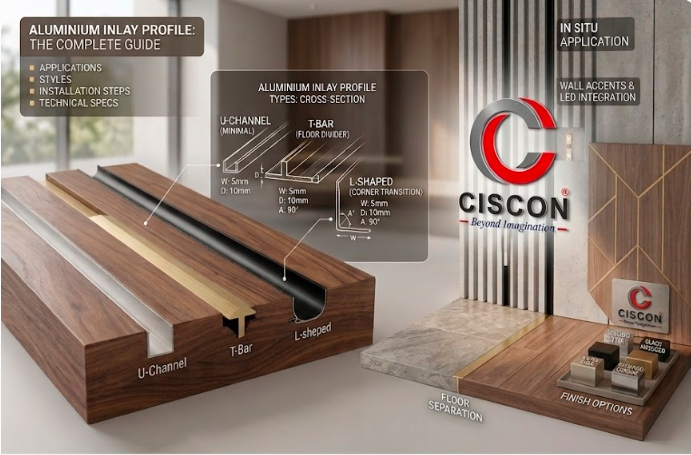
Aluminium Inlay Profile : The Complete Guide for Modern Interiors
If you've ever run your hand along a wardrobe shutter and noticed a thin, gleaming metallic line separating two panels of laminate, you've touched an aluminium inlay profile. It's a small detail, but it's the difference between a piece of furniture that looks assembled and one that looks designed.
This guide covers everything you need to know about the aluminium inlay profile — what it is, how it's made, where it's used, how much it costs, and how to choose the right aluminium inlay strip for your project. Whether you're an architect specifying materials, a carpenter sourcing from an aluminium inlay profile supplier in India, or a homeowner planning a renovation, you'll find practical, no-fluff answers here.
Quick Answer
An aluminium inlay profile is a slim, extruded or fabricated aluminium strip embedded into the joint or edge of laminate sheets, acrylic panels, wooden furniture, or wall paneling to create a decorative separating line. It hides seams, protects edges from chipping, and adds a premium metallic contrast to interior surfaces. Standard widths range from 2mm to 25mm, and profiles are available in anodized silver, gold, rose gold, black, and copper finishes.
Key Takeaways
- An aluminium inlay profile is a decorative and functional metal strip used to join, edge, or separate laminate, acrylic, and wood panels.
- It serves three purposes at once: aesthetic contrast, seam concealment, and edge protection.
- Common widths are 2mm, 4mm, 6mm, 10mm, and 25mm; standard lengths run 8 feet (2440mm) to 10 feet (3048mm).
- Finishes include anodized silver/chrome, matte black, gold/champagne, rose gold, and copper-tone.
- Pricing depends on width, finish, alloy grade, and order volume — expect a per-running-foot rate rather than a flat price.
- Correct fitting requires a routed or grooved channel matching the profile's base width for a flush, tight finish.
Quick Answer
An aluminium inlay profile is a narrow strip of aluminium — either extruded, roll-formed, or precision-cut — designed to sit flush within a groove cut into laminate, acrylic laminate, plywood, MDF, or veneer surfaces. Think of it as decorative piping for furniture: it runs along panel edges or between two contrasting surface materials to create a crisp, defined line.
The term "inlay" comes from traditional woodworking, where thin strips of contrasting material (originally brass, ivory, or dark wood) were set into a groove on a lighter surface to create ornamental patterns. Modern aluminium inlay strip products are the industrial evolution of this craft — mass-manufactured, consistent in dimension, and available in dozens of finishes that mimic brass, gold, copper, or brushed steel without the cost or maintenance of solid metal.
Expert Insight : In our experience supplying laminate and finishing materials since 1990, the profiles that perform best over time are those with a slightly wider base flange (the part hidden inside the groove) relative to the visible face — this gives the adhesive more surface area to grip, which matters more for longevity than the visible width alone.
Why is an Aluminium Inlay Profile Important ?
An aluminium inlay profile matters because it solves three practical problems simultaneously — visual continuity, joint protection, and design flexibility — that would otherwise need three separate materials or techniques.
- Visual continuity : When two different laminate colours, textures, or an acrylic laminate and a wood veneer meet, a raw joint looks unfinished. An inlay strip turns that seam into an intentional design line.
- Joint protection : Laminate and acrylic edges are vulnerable to chipping and moisture ingress at seams. A metal profile shields that vulnerable line.
- Design signalling : A thin metallic accent instantly reads as "premium" to the eye — it's one of the lowest-cost ways to elevate a modular kitchen, wardrobe, or reception desk from ordinary to designer-grade.
How Does an Aluminium Inlay Profile Work ?
The profile works through a simple channel-and-fit mechanism : a groove is routed into the substrate at the exact width of the profile's base, the profile is seated into this groove using adhesive (and sometimes mechanical clips for longer runs), and the panels on either side are then laminated or finished flush against the visible face of the strip.
The Manufacturing Process
- Alloy selection : Manufacturers typically use 6063 or 6061 aluminium alloy — chosen for extrudability, corrosion resistance, and finish quality.
- Extrusion or roll-forming : Molten aluminium is pushed through a die (extrusion) for thicker, structural profiles, or thin aluminium coil is roll-formed for slimmer decorative strips.
- Surface treatment : The extruded strip is anodized (an electrochemical process that thickens the natural oxide layer for hardness and colour) or PVD-coated (physical vapour deposition, for gold, rose gold, and black finishes).
- Cutting to length : Profiles are cut into standard 8ft or 10ft lengths, or custom lengths for bulk furniture manufacturing orders.
Types of Aluminium Inlay Profiles
Aluminium inlay profiles are categorised by cross-sectional shape, width, and finish — each suited to a different application.
By Shape
- Flat/Flush Inlay : Sits perfectly level with the surrounding laminate surface. The most common type for kitchen shutters and wardrobe panels.
- V-Groove Inlay : Has a slight recessed channel along its centre, catching light for a more dimensional, jewellery-like look.
- Raised/Bead Inlay : Sits slightly proud of the surface, creating a tactile ridge — popular on furniture edges and door frames.
- U-Channel Edge Profile : Wraps around a panel's edge rather than sitting between two panels; used for finishing exposed shelf or door edges.
By Width
| Width | Typical Use |
|---|---|
| 2mm - 3mm | Fine decorative lining between laminate panels, cabinet fronts |
| 4mm - 6mm | Standard wardrobe and kitchen shutter seams |
| 8mm - 10mm | Feature wall panel joints, reception desks, retail fixtures |
| 15mm - 25mm | Bold architectural accents, false ceiling borders, signage edging |
By Finish
- Anodized Silver / Chrome - the most common, cost-effective option
- Matte Black - favoured in contemporary and industrial-style interiors
- Gold / Champagne Gold - used in luxury and hospitality projects
- Rose Gold - trending in residential kitchens and vanity units
- Copper-tone - used for warm, boutique retail and café interiors
Benefits of Using Aluminium Inlay Profiles
- Corrosion resistance : Anodized aluminium doesn't rust, making it suitable for kitchens and bathrooms where humidity is a factor.
- Lightweight yet rigid : Aluminium is roughly a third the weight of steel or brass but holds its shape under normal handling and cleaning.
- Consistent finish : Factory anodizing or PVD coating gives every strip the same colour and sheen — unlike hand-finished brass, which can vary.
- Cost-effective compared to brass or stainless steel inlays : Aluminium delivers a similar visual effect at a lower material cost.
- Easy to cut and fit on-site : Carpenters can trim profiles to length with standard tools, unlike thicker cast metal trims.
- Wide finish palette : A single alloy can be anodized or coated into dozens of colours, giving designers flexibility without switching materials.
Key Features to Check Before Buying
Before finalising an order with any aluminium inlay profile manufacturer, verify these five specifications — they determine both the finished look and the working life of the installation.
- Alloy grade : Ask specifically for 6063-grade aluminium; lower-grade recycled alloys can pit or discolour over time.
- Anodizing thickness : Measured in microns; 10–15 microns is standard for interior use and resists scratching better than thinner coats.
- Base flange width : The hidden portion that sits in the groove — wider flanges bond more securely.
- Length tolerance : Confirm the supplier cuts to a consistent length (±1mm) to avoid gaps when joining multiple lengths on long runs.
- Colour batch consistency : For large orders, request profiles from a single anodizing batch — colour can shift slightly between batches.
Step-by-Step Installation Process
- 1. Plan the groove layout : Mark the exact position where the inlay will run on the substrate before any cutting begins.
- 2. Rout the channel : Using a router fitted with a straight bit matching the profile's base width, cut a groove to the correct depth — typically 60–70% of the profile's height.
- 3. Dry-fit the profile : Slide the aluminium strip into the groove without adhesive first to confirm a snug, flush fit.
- 4. Apply adhesive : Use a solvent-based contact adhesive or specialised PU adhesive along the groove and the profile's base flange.
- 5. Seat and press : Press the profile firmly into the groove, working from one end to the other to avoid trapping air bubbles.
- 6. Laminate the adjoining panels : Fit and press the laminate sheets on either side of the profile so they sit flush against its visible edges.
- 7. Clean and inspect : Wipe away excess adhesive immediately with a soft cloth before it cures, then inspect the full run for gaps or lifting.
Best Practices
- Always groove-fit rather than surface-stick a profile for load-bearing edges like shelf fronts — surface-stuck strips lift over time.
- Pre-drill pilot points for any profile requiring screws on long horizontal runs (over 6 feet) to prevent bowing.
- Store aluminium profiles flat, not leaning, before installation to prevent warping.
- Order 5% - 10% extra length to account for mitred corners and cutting waste.
- Match the profile finish to hardware (handles, hinges) elsewhere in the room for visual coherence.
Common Mistakes to Avoid
- Cutting the groove too shallow : This leaves the profile sitting proud and prone to catching or lifting.
- Using ordinary wood glue instead of contact/PU adhesive : Aluminium doesn't bond well with standard wood adhesives; this is the single most common cause of profiles coming loose.
- Ignoring thermal expansion on long runs : Aluminium expands slightly with heat; leave a small buffer at the ends on runs longer than 8 feet.
- Mixing finishes from different suppliers : Anodized silver from two manufacturers can differ subtly in tone — buy the full quantity needed in one order.
- Skipping a dry-fit : Applying adhesive before confirming the groove width wastes material if the fit is off.
Myth & Fact Table
| Myth | Fact |
|---|---|
| Aluminium inlay profiles rust like other metals. | Anodized aluminium forms a stable oxide layer and does not rust; it may oxidize on raw, uncoated cut edges only. |
| All aluminium inlay strips look the same. | Finish, width, shape (flat, V-groove, raised) and alloy grade change dramatically different results. |
| Aluminium inlays are only for luxury projects. | Standard silver-finish profiles are among the most budget-friendly edging solutions available. |
| DIY installation is not possible. | With a router and the correct adhesive, a skilled carpenter can install inlay profiles without specialised equipment. |
Material Comparison Table
| Material | Cost | Corrosion Resistance | Weight | Finish Range |
|---|---|---|---|---|
| Aluminium Inlay Profile | Low–Moderate | Excellent (anodized) | Very Light | Wide (anodized + PVD) |
| Brass Inlay | High | Moderate (tarnishes) | Heavy | Limited, needs polishing |
| Stainless Steel Inlay | High | Excellent | Heavy | Limited (silver/black) |
| PVC/Acrylic Inlay Strip | Very Low | N/A (not metal) | Very Light | Wide but less premium look |
Advantages & Disadvantages
- Elevates the perceived value of laminate and acrylic surfaces at low incremental cost
- Long service life when correctly installed with groove-fit and proper adhesive
- Wide range of decorative finishes from a single, consistent base material
- Simple to cut, mitre, and handle on-site compared to heavier metals
- Visible scratches on anodized finishes cannot be buffed out like solid metal
- Requires precise groove routing — a poorly cut channel undermines the finished look
- Thinner profiles (2mm–3mm) can bend if mishandled before installation
Common Mistakes to Avoid
- Modular kitchens : Separating shutter panels and edging cabinet fronts
- Wardrobe and closet interiors : Framing laminate or acrylic laminate door panels
- Office furniture and reception desks : Adding a defined, premium edge line to work surfaces
- Retail and hospitality interiors : Trimming display units, counters, and feature walls
- False ceilings and wall panelling : Framing charcoal moulding sections or wainscoting panels for a crisp border
- Signage and display fixtures : Edge-finishing acrylic or laminate signage boards
Common Mistakes to Avoid
- Matte black and graphite finishes are overtaking bright silver in contemporary residential projects.
- Mixed-metal detailing — pairing a rose gold inlay with matte black hardware — is increasingly common in kitchen and wardrobe design.
- Wider architectural profiles (15mm+) are being used as standalone design elements on feature walls, not just as seam fillers.
- Combination with liquid metal panels and UV marble sheets is growing, where an inlay strip frames a reflective or marble-effect panel for contrast.
Expert Tips from Ciscon Decor
- When ordering from an aluminium inlay profile supplier, always request a physical sample swatch before committing to a bulk order — screen colours and anodized finishes can differ.
- For kitchens, pair a 4mm–6mm silver or black profile with our acrylic laminate sheets — the high-gloss surface and the metallic line reflect light together for a noticeably richer finish than either material alone.
- On long corridor or false-ceiling runs, plan joint positions at natural break points (doorways, column lines) so seams in the aluminium strip aren't visually obvious.
- Keep offcuts — short lengths of profile are useful for edging smaller accessories like drawer fronts or trim panels later in the project.
Conclusion
An aluminium inlay profile is a small material choice with an outsized effect on how a finished interior reads — sharp, intentional, and well-built rather than merely assembled. Whether you're specifying a 4mm silver strip for a run of wardrobe shutters or a bold 15mm matte black border for a feature wall, getting the width, finish, and installation right is what separates a professional result from an amateur one.
If you're sourcing an aluminium inlay profile manufacturer or supplier for an upcoming project, Ciscon Decor's team can help you match the right profile width and finish to your laminate or acrylic surfaces. Contact Ciscon Decor today at +91 8767776616 for samples, pricing, and bulk order support.
Frequently Asked Questions
An aluminium inlay profile is used to join, edge, or decoratively separate laminate, acrylic, or wood panels in furniture and interiors, hiding seams while adding a metallic accent line.
Standard widths range from 2mm to 25mm, with 4mm and 6mm being the most common sizes for wardrobe and kitchen shutter applications.
No. Anodized aluminium forms a stable, corrosion-resistant oxide layer, making it suitable for humid environments like kitchens and bathrooms.
Pricing is typically quoted per running foot and depends on width, finish, and alloy grade. Contact an aluminium inlay profile supplier in India directly for a current, project-specific quote, since raw material rates fluctuate.
A skilled carpenter with a router and the correct adhesive can install these profiles; however, precise groove routing is important, so experienced installation is recommended for a flush, gap-free finish.
Common finishes include anodized silver, matte black, gold, rose gold, and copper-tone, achieved through anodizing or PVD coating processes.
Edge banding wraps and seals a panel's raw edge, usually in matching laminate or PVC, while an inlay profile is a decorative metal strip set into a groove, typically between two panels or along a visible seam.
6063-grade aluminium is the industry standard for interior inlay profiles due to its extrudability, strength, and consistent anodizing response.
Yes, aluminium inlay profiles pair well with acrylic laminate sheets, since the high-gloss laminate surface and the metallic strip both reflect light, enhancing the overall premium finish.
When correctly groove-fitted and bonded with the right adhesive, anodized aluminium inlay profiles can last as long as the furniture or panelling itself, typically well over a decade, with minimal maintenance.
A router with a straight cutting bit for the groove, a measuring tape, a mitre saw for corner cuts, and a suitable contact or PU adhesive are the core tools required.
Most manufacturers supply standard 8-foot or 10-foot lengths, but custom lengths and cut-to-size orders are commonly available for bulk furniture manufacturing projects.